Category Archives: Life

Dust, And A Water Bottle.

“Dad? When are you going to die?”
“Sweets–I’m dying right now.”
“Daddy, you’re not dying!”
“Yes I am. A little bit every day. I’m certainly not growing.”

We were walking to school. I had reminded her that today was Ash Wednesday, and that at the service, ashes would be placed on her forehead as the minister says, “Remember you are dust, and to dust you shall return.” The next steps were quiet ones.  Standing at the corner of a busy street, we waited for the traffic to clear. After we crossed, I broke the silence.

“If I’m lucky, I’ll live another fifty, or sixty years. That would be nice, don’t you think? I could watch you and your brother grow up, maybe get married and have kids…” Grandchildren and great granchildren. That would be cool. I felt myself starting to day dream as we walked. I could go with this, for a while. Sweets wasn’t about to wander with me.

“Dad! You’ll be over a hundred years old! That’s too old!”
“Is it? What if I don’t feel a hundred? When I was twenty-five, I would look at people who were thirty. I thought they were so old. Then I turned thirty and I felt like did when I was twenty-five. And you know what?”
“What?”
“The same thing happened when I turned forty. Isn’t that weird?”
“Yeah. But when you’re a hundred, I’ll be… fifty. That’s really old!”
“Thanks.” I shrugged my shoulders, feigning insult.
“Da-ad. You know what I mean. Besides, you’re not that old, yet.” She smiled. “Do you still feel like you’re twenty-five?”

We’d reached another corner. She checked for passing cars. “I don’t know,” I said. I thought about her question as we crossed the street. “Got it. I feel, thirty-five. And if I’m healthy when I turn a hundred, maybe I’ll still feel this young!” I smiled. I also saw an opportunity for a little teasing. “Hmm… If I feel thirty-five, maybe I should date someone in her thirties? Of course, if she really is in her thirties, she’ll feel like she’s twenty-five. That probably wouldn’t be good. Twenty-five is definitely too young.” I continued rambling until we reached the end of the block.

After we crossed, Sweets looked at me, cocked her head to one side and said, “Dad. You’re crazy.”
“I know. And annoying.”
“Especially when you dance.” We were both grinning. She, was serious. She skipped ahead and waited for me at the next corner. Cross that street and we’d arrive at her school. She checked her bag while she waited for me to catch up.
When I reached her, she asked me, “Do you have my water bottle?”
“Do you mean the one I asked you to put in your bag?”
She looked down, her hand was balled into a fist. “I hate when I do that! I always forget things. Always. Why can’t I remember?”

I wanted to help her reset. Sweets has high standards for herself. Sometimes I think they’re too high. I leaned forward, and put my hand on her shoulder. “Don’t blame yourself. I can get it. Things like this aren’t a big deal. They happen.”
She kicked the ground with her shoe. “I don’t like it when it does.”
“I know. Hey. I’m going to tell you something else about Lent.” She rolled her eyes, as if on cue. “Tonight the minister might also say, “Repent, and believe in the Gospel.” We repent because we don’t always do things the way we’re supposed to. That can be about getting along with your brother, or doing the things your mom and I ask you to–”
“Dad, you really are annoying sometimes.”
“Yeah. I am. Listen, maybe Lent is about accepting that you’re not perfect, and realizing you don’t have to be. Do you want to remember things like your water bottle? Sure. But the idea that you can’t make mistakes? I think that’s the worst sin, ever.”
She reached forward and gave me a hug. “I love you, Daddy.”
I kissed her on the cheek, “I love you too, Sweets. Go inside. I’ll be back in a few minutes.”

2012. Are We There Yet?

Last night I wished a friend of mine a happy new year. She replied that I was too early with my greeting. Surely we’d speak again before the new year. Then I wished her a happy end of the year. She said I was still speaking too soon. Later, as the clock ticked past midnight, and the date rolled over to December 31, I wished her a happy end of 2011. She smiled, and bid me goodnight.

One of my favorite lines from the Pixar film The Incredibles is Mr. Incredible’s response to that classic car travel question, “Are we there yet?” “We’ll get there when we get there!” is his wonderful reply. These days, when the kids ask me that question, it’s with a smile forming on their faces. They expect the Mr. Incredible reply. Instead, they’re more likely to ask, “How much longer?” What they’ve learned, I think, is that unless we’re stopped in traffic, the answer to their question gets smaller and smaller each time they ask. It’s also a sign that they’re living in larger swathes of time. Six hours is long, but no longer an eternity. Five and a half hours is shorter. So is four. And three. Time gets longer in the last hour. That hour still takes forever. That’s a burden stemming from the wonder of anticipation. It takes forever for me, too.

Another year is upon us. It may take a long time to get to midnight tonight, especially if you are outside, and it is cold where you are. Soon 2012 will be done, as well. We’ll be on to 2013. That year will also pass faster than we believe. “Where did it go?” we will ask. I love the way finding myself in the flow of experience, removes the felt sense of time. You lose yourself so completely, you’re no longer aware that hours have passed, not until the trip to the beach is over, or the book you’re reading ends. Those are times when we’re fully present to life. It’s also the only part of our waking time, that resembles a good night’s sleep. The kind of night where sunlight streaming through a window is enough to roust you, and you beat the alarm clock at your side. I love wakings like that!

My favorite birthday greeting is a variation on the following. “Here’s to the year ahead and all it holds! May your lap overflow with all manner of good things. And in the difficult times, which will come, may you remember your friends and family are at your side.” I’ll let that be my wish for your 2012. Am I too soon? If you think I am, pretend you’re on the other side of the International Date Line. The rest of us? We’ll get there when we get there!

Lent’s Compass. Day Twelve: A Human Love

As Christians we are not meant to be less human than other people, but more human, just as Jesus of Nazareth was more human.
One time I was talking to Canon Tallis, who is my spiritual director as well as my friend, and I was deeply grieved about something, and I kept telling him how woefully I had failed someone I loved, failed totally, otherwise that person couldn’t have done the wrong that was so destructive. Finally, he looked at me and said calmly, “Who are you to think you are better than our Lord? After all he was singularly unsuccessful with a great many people.”
That remark, made to me many years ago, has stood me in good stead, time and again. I have to try, but I do not have to succeed. Following Christ has nothing to do with success as the world sees success. It has to do with love.
~ Madeleine L’Engle Walking On Water, pp  59-60.

As a parent I identify with L’Engle’s conversation with Canon Tallis. It’s not that Sweets or Bud have ever done anything that was “that destructive.” Still, the days where I could look at them for hours are gone. Even before they could talk they were the “most beautiful boy” and the “most beautiful girl” I’d ever seen. I know, yours were too.

Don’t get me wrong, I marvel at the people they’re becoming. It’s just that when they catch me, it’s not cooing or a cutely mashed up word I hear. There are no new Vinny Mans or Popscillos. They don’t just talk. They talk back. “Dad, why are you staring at me?” or “Dad? You can leave my room now.” Those are not the most pleasant interactions.

I used to wonder what was wrong with me. Why couldn’t I do a better job at parenting? When Bud was young and needed a nap things were easy. I’d put him in the bouncy chair or take him on a five minute car ride and he’d fall asleep within a few minutes. Now it seems that most of my tactics raise anxiety instead of reducing it. With him. With me. Sometimes their mom calls to vent. In measured tones she says, “You’re not going to believe what he just said to me.” She describes what’s happened. What she tells me, is the same thing he said to me a day or two before. I sigh. It’s not me. I know that now. Most of the time. But it’s nice to have that confirmation.

Bud is becoming his own person. Sweets is often fast to imitate her big brother. That’s double trouble from two fabulous kids whom I love dearly. And now I remember that the five minute car ride eventually turned into a twenty minute one with the heat on. They stopped when he and later she were done with naps. Their mom and I had no say in the matter.

There are bunches of changes to come as Bud moves through his teenage years and Sweets follows. Individuation is like that. Bud’s already showing me that he hasn’t only learned the lessons his mom and I were trying to teach him. He’s absorbed everything. He’s going to continue to do so. Me? I’m not sure I’m a better parent today than I was ten years ago. I am different. There’s no Super Dad. Just a guy who tries to love him as much as I can.

Lent’s Compass. Day Five: Quakes, Waves and Sonnets

“You mean you’re comparing our lives to a sonnet? A strict form, but freedom within it?”
“Yes,” Mrs. Whatsit said. “You’re given the form, but you have to write the sonnet yourself. What you say is completely up to you.” ~ Madeleine L’Engle, A Wrinkle In Time.

Like many, I’ve been thinking about the tsunami that followed Thursday’s earthquake in Japan. The event calls to mind our agreement regarding what L’Engle–in comparing life to a sonnet–calls the “strict form” of life.

We live most days without thinking about the way we agree on the nature of this “strict form.” We know to avoid casual conversations about politics, religion and the specifics of how another parent should raise their child. We share a clear agreement to not discuss these things in public.

Many of us also lean towards the hopeful side of the form, believing that if we pray hard enough, hope hard enough, believe hard enough and work hard enough, only good things will happen in our lives. Less daringly, we urge each other to do these things so that circumstances will get better.

Watching the waters wash everything away is stunning and transcendent. Clearly there is nothing a single person can do “hard enough” to slow the waters inland push. We are pulled towards two forms of the same question: Why? and How could God let this happen?

Aside from a discussion concerning the science of plate tectonics, these are not questions that can be answered.

That doesn’t mean folks won’t try. Glenn Beck is already echoing Pat Robertson from a year ago. He is blaming the victims, assuring his listeners that there is a reason! I’m not sure if he’s thought of one yet, but I won’t be surprised if he does.

At America Magazine, James Martin, Why Do We Suffer? discusses perspectives on the question offered by the Jewish and Christian traditions. If you’re as flummoxed by the question as I am, the full piece is worth the read.

At the end of the story Martin notes that because a question cannot be answered, it doesn’t mean that you have to blindly accept the result:

“When we are suffering, our friends will want to help us make sense of our pain, and they will often offer answers . . . Some answers may work for us. Others may leave us cold or even be offensive. But, in the end, every believer must come to grapple with suffering for ourselves. And while our religious traditions also provide us with important resources, ultimately, we must find an approach that enables us to confront pain and loss honestly with God.”

Earthquakes, Tsunamis and all manner of natural disasters challenge faith. We have visceral reaction to hearing words that blame others for them. I think that shows we’re aware that it’s a mistake to do so. When we blame God for not stopping these events, I think we make a similar error.

We cannot answer the question of why suffering happens. It is part of the “strict form” of life. Perhaps the freedom within the strict form of our sonnets, isn’t found in the answer to why suffering happens. Instead, maybe it’s found in the way we respond to it.

Lent’s Compass. Day Two: A Running Man

“When spring-fed Dog Pond warms up enough for swimming . . . I often go there in the late afternoon. Sometimes I will sit on a sun-warmed rock to dry, and think of Peter walking across the water to meet Jesus. As long as he didn’t remember that we human beings have forgotten how to walk on water, he was able to do it. . . . One of the great sorrows which came to human beings when Adam and Eve left the Garden was the loss of memory, memory of all that God’s children are meant to be. Perhaps one day I will remember to walk across Dog Pond.” ~ Madeleine L’Engle

Tuesday afternoon while walking to Sweets’ school at the end of the day, I realized I was without my cell phone. I returned home and retrieved it. Checking the clock as I headed out the door I grasped that I had three minutes to complete a six minute walk. I picked up the pace. Walking briskly, a odd thing happened. This was not something unusual in the way seeing a blind man ride a bike is. This was strange for me. It was wonderful too. As I walked, I found myself increasing speed without consciously trying to. I was merely trying to walk quickly. Suddenly I broke into a trot. I was running.

I looked down at my feet and watched them. I began to cry and worried that I might trip. I was looking at the ground, not where I was going. My eyes were full of water. Everything was a blur. I stopped, looked up and wiped the tears from my eyes. I was half a block from the school. I walked the rest of the way.

Arriving, I hip-checked one of my favorite mom’s, punched a dad in the arm, fist-bumped another and high-fived a precocious third-grader. He, I’m sure was just happy to make it through the end of a school day. In my mind I was replaying the scene in the film Rocky where Rocky triumphantly stands on the steps of The Philadelphia Museum of Art. This was my first experience of running freely in almost two years.
Running is something I forgot how to do after my stroke. I understood the mechanics of it. I knew the way my body needed to move. I just didn’t know how to get it to move the way it needed to. I became aware of this during a neighborhood kickball game a few months after leaving the hospital. Today I look back and wonder what I was doing playing kickball. At the time, I only knew what I knew. I was only able to live in the present moment. I had no yesterday. No tomorrow. No next. Blissfully, I had no anxiety either. I was wherever I was, in the way I was. So, I joined in.

During my first “at-bat” I kicked the ball as best I could and started to run. My run turned into the long stride of one leg. The other lagged behind. I lumbered toward first base. This was a game of “Parent’s versus Kids.” The kids were all in elementary school. I was out. They were delighted.

With practice, my performance improved. And yet, as late as this last Christmas, I’ve been aware that when I try to cross a major intersection on foot, my torso arrives before my legs do. They can’t keep up the pace. At least, that was my experience. I’d forgotten how to run. Now I remember. What was impossible is unselfconscious and glorious once more.

I don’t know if Madeleine L’Engle ever remembered how to walk across her Dog Pond. This Lent, as you reflect on things you’ve forgotten perhaps, you’ll find yourself running across yours. Impossible you say? And yet, blind men teach themselves to see (and ride bikes).

Everyone Makes Mistakes

Last night like many people, I was watching the TV show, Grey’s Anatomy. I think sometimes that I worship at the Church of Grey’s. One of the things I like about the show is that it’s so full of life. Episode to episode, folks take a step forward and then one or two back. Episodes don’t resolve in nice packages in the last few minutes, the way many shows do. It’s complicated. There’s no saving the world on Grey’s Anatomy. It is that way because life is that way.

The lesson of last night’s episode was “everyone makes mistakes.” It’s such a fundamental truth. Once an error has been made, it’s rare that a single decision or action will remedy it completely. More often, when we attempt to right things with a single conversation or email, we make things worse.

The only way to get to the other side of an error, of a mistake, is to move through it. Step by step. Moment by moment. Conversation by conversation. Along the way, keep reminding yourself that everyone makes mistakes.

Tagged

Being Part of Something Special

CNN is reporting that in the aftermath of hurricane Ike, “Starbucks stores have…turned out to be places where people can get together to share information and comfort each other.”

Reading that reminded me of an anecdote a friend from San Diego shared with me last year when wildfires were raging north of L.A., in Orange County and San Diego.

A customer came into the Starbucks store he manages and exclaimed in thanksgiving: “Firemen; Policemen; Post Office and you guys!”

That’s being part of something special.

Moving On

I’ve been catching up on old issues of The New Yorker. John Colapinto wrote a nice piece on Paul McCartney in the June 4, 2007 issue. McCartney turned 65 last year. That’s one year past his wondering if we would still love him. Colapinto writes, “it’s a milestone he finds difficult to contemplate. “The thought is somewhat horrifying,” he told me. “It’s like, ‘Well no, this can’t be me.'”” I can’t believe it either. How did this happen? How is it also that my hippest cousins are his senior?

I understand something of Woody Allen’s obsession with death and that’s not necessarily a good thing. I have witnessed wonderfully vibrant souls die and realized again and again, that when someone dies, it’s before their time. Even when you can say it was time or they tell you they are ready, you’re not. There is always loss.

The deaths of three public figures touched my heart last year and two recent ones are front of mind in 2008.

Phil Rizzuto, August 13, 2007.
Growing up, I remember the shortstop pitching for “The Money Store” on WPIX in New York. http://www.youtube.com/watch?v=nDQHQkuv9l0. The commercials aired late at night and in between innings of Yankee games. Broadcasting was Rizzuto’s second career, where he was at different times paired with Frank Messer, Bill White and Fran Healy. He always called them by their last name. “Holy cow!” was his signature cry signaling a Yankee hit or rally. But what sticks in my mind are memories of the small things he talked about during games that reminded you he was a person and not just someone with a function. Whether he was talking about Cannoli, his need to “get over the bridge” (GW) or his fear of lightning, he let the broadcaster’s veil fall. On the periphery were lessons that life is bigger than the job you do.

Luciano Pavarotti, September 6, 2007.
His rendition of Nessun Dorma was his trademark. Say what you want about his career or talent, his voice had a special quality, an ability to bear and hold emotion like few others. I was listening to a podcast of the WBUR show, “On Point” the day he died and a caller to the show, identified only as David from Hoptkington, said it better than I can.

“Pavarotti was one of those people who as a human being could produce a single tone, a single tonality of such amazing power and grace, that you don’t have to understand the language, you don’t even have to hear much of what’s coming before then. But when that note strikes you it’s like, um, well it’s, in Pete Townshend’s words it’s “there once was a note pure and easy playing so free as a breath rippling by, the note is eternal it hears me, I hear it, it sees me, forever we’re blended, for ever we die” and as a singer I’ve always looked in my own part to achieve that single note that for me would be like, sort of like the true voice of God coming through a human being. And I’ve never seen Pavarotti, I’ve never really paid a lot of attention to opera, but when I hear those notes, it literally brings me to tears. So this morning I’m driving to work and I’m sitting there and bang, with no other prompting it was just–it’s just that powerful.”

The lyrics to that song are as beautiful as the melody itself:

No one sleeps! / No one sleeps! / Even you, oh princess, / in your cold room, / look at the stars / that tremble with love / and hope!
But my mystery / it is locked in me. / And my name, / no one will know! / No, no!
On your mouth / I will say it, / when the light / will shine!
And my kiss will break the silence, / that makes you mine!
choir:
His name no one will know… / And we shall have, alas, to die, to die…!
Disperse, o night! / Vanish, oh stars! / Vanish, oh stars!
At daybreak, I will win! / I will win! / I will win!

Joe Zawinul, September 11, 2007.
I saw him in concert in 1978 or 1979 with his band Weather Report. As with Pavarotti and Nessun Dorma, there is something wonderful about Zawinul’s music. A stillness that reminds me of the importance of pausing and giving witness to the moment. A Remark You Made is a tender tune of his from Weather Report’s 1978 album Mr. Gone.

Jim McKay, June 7, 2008.
I grew up listening to him as he hosted ABC’s Wide World of Sports and the Olympics. In 1972 I didn’t understand what was happening at the games in Munich. They were an Olympics of Frank Shorter, Steve Prefontaine, Mark Spitz and Olga Korbut. They were an Olympics of terror. McKay reported the news of the hostage-taking as well as event results. The gravity and tragedy of those games came through in the negative contrast of his reporting. Here’s a video that will give you a sense of McKay at those games:

More than two decades later his voice cracks as he recounts the tragedy at Munich. That’s his heart. He pulls us together as he shares it, in the way people are brought together through their own woundedness.

Randy Pausch, June 25, 2008.
His “Last Lecture” message for his children went viral. I missed it early on and only caught up with it in April. This message has a richness that compares to Pavrotti’s singing and Zawinul’s compositions. He speaks plainly like Rizzuto and from the heart like McKay. So much so that when I heard it I was convinced that I’d met him here in Pittsburgh. It’s that honest and plain. It’s mystical. Here’s the Carnegie Mellon University news story: http://www.cmu.edu/homepage/beyond/2008/summer/an-enduring-legacy.shtml. There is a link to the last lecture at the bottom of the page.

At my parent’s 50th Wedding Anniversary party in June, the love in the room was palpable. I’m not just talking about my parents. The grace of marriage is carried through friends and family. Those that gather to witness two people proclaim their love for each other and those who enter their lives after. These all commit to accompanying the couple on their journey wherever it might lead. I think that happens whether they know it or not. Fifty people joined my parents at their party. Hundreds if not thousands more shared in the journey.

During the party I found myself looking for people who weren’t there. People who I grew up with. People who helped raise me simply by loving my parents. Some had schedule conflicts or couldn’t come. Others would only attend in our memories. They’d moved on.

Tagged , , , , ,

Mary Oliver’s The Journey

This is about perspective.

The Journey by Mary Oliver

One day you finally knew
what you had to do, and began,
though the voices around you
kept shouting
their bad advice —
though the whole house
began to tremble
and you felt the old tug
at your ankles.
“Mend my life!”
each voice cried.
But you didn’t stop.
You knew what you had to do,
though the wind pried
with its stiff fingers
at the very foundations,
though their melancholy
was terrible.
It was already late
enough, and a wild night,
and the road full of fallen
branches and stones.
But little by little,
as you left their voices behind,
the stars began to burn
through the sheets of clouds,
and there was a new voice
which you slowly
recognized as your own,
that kept you company
as you strode deeper and deeper
into the world,
determined to do
the only thing you could do —
determined to save
the only life you could save.

Nothing Fancy

In April of 1987 I began keeping a book of poems. The book is a marbled green variation of the classic composition notebook. Except the cover is stiff and inside you’ll find graph paper, not lined. I’ve kept it– treasured it–for twenty years. From time to time, I’ve added another poem to the collection. The journal–that’s what it really is–opens with two poems from 1985, but they are not the only thing the book holds.

Here’s what I found inside the cover:

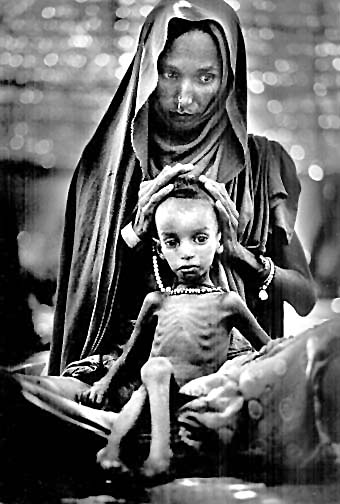
A yellowed copy of Stan Grossfeld’s Pulitzer prize winning photo of an Ethiopian mother and child in Wad Sharafin Camp in the Sudan from 1984. I’d cut it out of the Boston Globe when it was originally published. I consider the image to be the epitome of the Third World Madonna and Child. I also have a photocopy of the same newspaper clipping. The original has held up better.

A short essay by Linda Weltner. She used to write a column titled, “Ever so humble…” for the Boston Globe. This one is about marriage. I’m not sure what year it’s from, but I remember being struck by these lines, “Marriage is no safe harbor. There’s danger there, and a dark surge of powerful emotions. Over the years I’ve contemplated murder and known true contentment. I’ve felt trapped and liberated, challenged and defeated, in despair, yet determined to keep this love alive.” As I struggled through my marriage, I often hearkened back to them hoping I could sustain what was a very flawed relationship. In reviewing it now, I realized I’d never remembered the words that followed that sentence: “The decision to marry means having faith in your own power to create the life you want with the person you have chosen, and that is something [couples] have to find within themselves.”

There’s a draft of a poem–or was it a song?–written in 1999 to a friend at LSU I’d lost and found and was losing again. Did I ever send it? Did I finish it? I have no idea. The draft itself is coarse sandpaper rough. I still hope to find her and look from time to time.

Another clipping. A photo cut from the National Catholic Reporter of a Peruvian Crucifix sculpted by Edilberto Merida. The Christ figure is rendered in a traditional indigenous form. The hands, feet and facial features are all oversized. Like the Grossfeld photo, this is a Christ of the poor.

The last clipping is an article from the Sunday Globe from 1989 by David Nyhan on the growing numbers of refugees throughout the world. I’m pretty sure I kept it because the story frames the Grossfeld photo.

After that a page left blank followed by two poems from 1985.

I remember buying the book to hold a flurry of poems I found myself writing. The two from ’85 had probably been written on individual pieces of paper and saved. That was a time in my life when I would write as inspiration struck and present my poems as random gifts to friends and strangers.

Twenty years later I begin this virtual book where I will endeavor to write from time to time as inspiration strikes. Here you’ll find links, clippings and musings of mine. Nothing fancy, just plain text notes.

Tagged